| נשלח ב-26/1/2011 06:39 |
 |
| |
נייע בוך פון בעל דברי יואל מ'סאטמאר זי"ע

|
|
|
|
| נשלח ב-13/12/2011 12:11 |
|
| |
 Rabbi Chaim Moshe Stauber, author of the just-published biography of Rav Yoel Teitelbaum, zt”l. In a close relationship that spanned twenty years, speaks to Feldheim publishing on his experiences with the Rebbe during the month of Kislav Rabbi Chaim Moshe Stauber, author of the just-published biography of Rav Yoel Teitelbaum, zt”l. In a close relationship that spanned twenty years, speaks to Feldheim publishing on his experiences with the Rebbe during the month of Kislav
New York - We are privileged, dear readers, to give you a special pre-Chanukah treat—an up-close, personal account of how a contemporary Torah luminary, the Satmar Rebbe, zt”l, conducted himself during Chanukah, from the vantage point of Rabbi Chaim Moshe Stauber, author of the just-published biography of Rav Yoel Teitelbaum, zt”l. In a close relationship that spanned twenty years, Rabbi Stauber drank deeply from the holiness and Torah of his Rebbe, even spending time as the Rebbe’s hoiz-bochur. In this exclusive interview, Rabbi Stauber shares with us an insider’s view of Chanukah in the Satmar Rebbe’s inner circle. So step into the Rebbe’s court for a few, precious moments, and enjoy! RP: Could you describe to us, please, the atmosphere in the Rebbe’s court as the month of Kislev was heralded in, and Chanukah approached? RCS: The month of Kislev was not much different from most other months. For the Rebbe, every aspect of life was based on Torah and so, as Kislev approached, he encouraged more hours of learning in the Yeshivah, and his divrei Torah were more focused. On Parshas Vayishlach, the Rebbe frequently cited the Ramban that states that whatever occurred to our Avos was a symbolic model of that which would ultimately happen to Bnei Yisrael in Galus, Exile. Many of these divrei Torah were printed in the Rebbe’s sefer, Divrei Yoel. As it happens, most years, Parshas Vayishlach coincides with Kaf-Alef Kislev, the 21st day of Kislev, which is an auspicious day for Satmar and for many other branches of chassidus. It is the day that the Rebbe was saved from the hands of the Nazis, when we celebrate our spiritual survival. RP: Some of our readers may not be familiar with this celebration. Can you tell us more about Kaf Alef Kislev? RCS: Kaf Alef Kislev is a major celebration to this day, with live music, dancing and festive speeches on the real message of the day for all Torah Yidden. In most places around the world, huge crowds gather together for a lengthy evening at tables served and catered with a full meal and countless stories told of the suffering under the Nazis ym”s and the miracles of survival of the Rebbe and others. In years past, before the Rebbe suffered his stroke, Kaf Alef Kislev was celebrated separately from the Annual Satmar Dinner, which raises money for the Yeshiva. Afterwards, to make it easier for the Rebbe to attend both events, the two were combined, and this practice has continued in most places – including Eretz Yisroel – to this day. In his talks during these celebrations, the Rebbe talked about how we must remember the millions of Kedoshim who perished; we are certainly not better than they were! He urged us to fulfill our duty to give thanks to Hashem for saving us, by redoubling our service to Him, as a meaningful expression of gratitude. A famous vort the Rebbe often gave was about Moshe Rabbeinu. Moshe Rabbeinnu named his eldest son Gershom, reminiscent of his being a “Ger”, a stranger in the land of Midyan. His second son was named Eliezer, in thanks for Hashem saving him from the sword of Pharaoh. The question the Rebbe raised was this: Shouldn’t the names have been in the reverse order? First, Moshe had been saved from the sword of Pharoah, and only later was he a stranger in Mitzrayim! The answer the Rebbe stressed was that when Moshe fled to Midyan and was able to maintain his service of Hashem, he was subsequently able to express his gratitude for being saved from Pharaoh. If not for the ability to serve Hashem, then the physical salvation is incomplete! I have found an interesting connection between Chanukah and Kaf Alef Kislev – the day the Rebbe, zt”l, was saved from the accursed Nazis ym”s. The Gemara in Masseches Shabbos begins the sugya of “Maiy Chanukah” on none other than…Daf Kaf Alef! In fact, the substance of both celebrations—Chanukah and the Rebbe’s salvation—have a lot in common. RP: It sounds like the atmosphere in Satmar intensified as Chanukah approached, what with the celebrations of Kaf Alef leading up to Chanukah just a week later. How did the Rebbe conduct himself during Chanukah? RCS: Every night, the Rebbe gave lengthy shmuessen on the topic of Kedushas Am Yisrael, the holiness of the Jewish Nation. All these discourses were organized as a type of a series, with continuations on the same topic every night. The Rebbe spoke about how the main objective of our enemies was to defile and render impure our holiest of vessels, including the “Shemen zayis”, the olive oil, which refers to chachmas HaTorah, the wisdom of Torah, and that unlike Purim, which posed a physical threat to the Jews, we celebrate our spiritual survival on Chanukah. The Rebbe conducted himself mostly according to the customs he had inherited from his illustrious father the Kedushas Yomtov. He did not wear a shtreimel on Chanukah. There were no special external trappings; he had a nice, large silver menorah and he lit the wicks for the oil with a yellow wax candle. Every single night there was a special choir comprised of older bachurim and young boys—often including a chazzan and soloists—with new niggunim prepared every year. They started singing when the Rebbe gave a signal, usually about 30 minutes after lighting, after he finished saying the special tefillos recited on Chanukah. The Rebbe’s uttering of the candle-lighting brachos was like thunder and it penetrated all hearts, but he always swayed gently and refrained from showing any excessive external body movement. However, all present could easily visualize the meaning of, “Al yedey kohanechu hakedoshim “. RP: Did the Rebbe have any shitos about the modern-day trappings of Chanukah, such as gift-giving? RCS: Let me state that the Rebbe was very much opposed to any celebrations – or gift-giving – on Chanukah. The only tisch conducted every night after the choir concluded its singing of “Haneriros halolu” and “Ma’oz tzur” was comprised of sitting down in the middle of the Beis Medrash, which was configured differently than on Shabbos and Yomtov, at which time the Rebbe said divrei Torah, leading into decrying all those who deviate from the path of our holy ancestors. Once the Rebbe concluded his divrei Torah, the crowded Beis Medrash, filled with many Rabbonim and Roshei Yeshiva who had come to hear the Rebbe’s words, echoed with a thunderous ‘Omein’. Then the Rebbe made a bracha and took a sip from a small cup of Slivovitz, saying a loud “Lechayim!” and waving his hand to the crowd that later partook of his Shirayim leftovers. Every night of Chanukah, the Rebbetzin Alta Faiga, a”h, would stand by the door, always in the company of a relative, collecting tzedakah for the poor and needy. During the day, she would go visit the children in the Yeshiva and hand out pekelach of sweets as well as a Tehillim or Siddur, as a personal gift. (After the Rebbe suffered his stroke she was forced to curtail these tasks, and often sent somebody else to represent her.) Hearing the Rebbe daven Hallel every day was a real sweet treat—better than any latkes or donuts. The last night of Chanukah, “Zois Chanukah”, the choir added in the singing of Mizmor Shir Chanukas habayis (Tehillim 30). In the afternoon, the Rebbe handed all the boys who had sung in the choir Chanukah-gelt, to reward them for their nightly performances for which they had prepared and practiced for weeks beforehand. I believe that the Rebbe washed on Zois Chanukah, in the privacy of his residence, with two more individuals invited in at the end to make zimun for bentsching. RP: Are there any specific divrei Torah or points of hashkafah that the Rebbe stressed, which could inspire our readers during these days? RCS: These are a few important points which the Rebbe constantly stressed: 1. The Rebbe urged his listeners to understand the meaning of the words in the bracha we make: “Bayomim hoheim bizman hazeh”, to be literal—that Hashem is Omnipresent and the same as He was then. Thus, those same kochos that He manifested then are present today, displayed to us through Torah and Avodas Hashem b’kedushah u’vetaharah, with sanctity and holiness. 2. As Chazal states, Hashem has not wrought miracles for nothing, and it is our duty, as Torah Yidden for whose service the world was created and maintained, to find relevance to ourselves and today. We have to keep in mind the “B’zman hazeh”—how can we strengthen our emunah in the basic Thirteen Ani Maamins and keep in mind the comforting pasuk, “Ani Hashem, lo shanisi, ve’atem Bnei Yaakov, lo kilisem.” (Malachi 3), “I am Hashem, I have not changed, and you, the Jewish Nation, have not been destroyed.” 3. The most dangerous mixture in Yiddishkeit is Torah with, lehavdil, secularism. Those who try and narrow the gap between Kedusha and Tumah are compared to someone serving kosher food in traif utensils, rendering all of it unkosher! 4. All of the sifrei kodesh are replete with the idea that the ‘sitra achra’, the Evil Inclination, always tries to snatch from our Torah and Mitzvohs, like vultures, by which it gains strength, thus prolonging our Exile and preventing the Geulah from coming. The lights of Chanukah are a semblance of the Geulah, like the pasuk says: “Orachti ner limshichi…”, “I prepared a light for my Anointed One.” (Tehilim 132) Thank you to Rabbi Chaim Moshe Stauber for sharing his vignettes and insights with us. May we be zocheh to see that radiant “light for my Anointed One” speedily in our days. Amen!
 |
|
|
|
|
|
| נשלח ב-13/12/2011 21:58 |
|
| |
געוואלדיג ווי איך פארשטיי איז דאס די לאנג ערווארטעטע ארבעט פון נטרונה ניין?
|
|
|
|
| נשלח ב-3/3/2013 06:12 |
|
| |
http://patentlyjewish.com/satmar-rebbe-biography
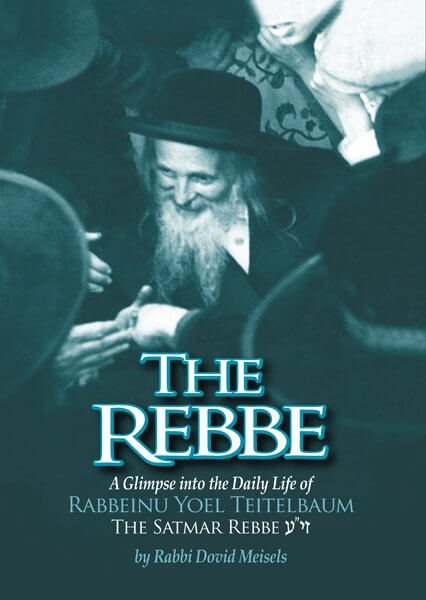
 There are two English-language biographies of the Satmar Rebbe. I tried them both, and the clear winner is the publication from Israel Book Shop by Rabbi Dovid Meisels. There are two English-language biographies of the Satmar Rebbe. I tried them both, and the clear winner is the publication from Israel Book Shop by Rabbi Dovid Meisels.
Some BackgroundThe Rebbe was clearly exceedingly intelligent, exceedingly idealist, and exceedingly devoted to serving the Creator in whatever circumstances he was placed. His religious views are often thought of as extreme, but his interpersonal relationships and understanding of how other’s think was amazing. This is a man who was held by the Nazi’s, on his way to an extermination camp, but was saved by Rudolf Kasner, of all people. Kasner, like the Rebbe was a Hungarian Jew, but he had purposely left the world of Torah Judaism in exchange for secular Zionism and met with Adolph Eichmann, handing over lists of Jews while determining who would live and who would die. Kasner chose a few hundred Jews to be saved, one of them, the Satmar Rebbe because, according to the book, Kasner had a dream where his now deceased Torah observant mother told him to save the Rebbe. Kasner himself was later assassinated in Israel in 1952 for being a Nazi collaborator. Anti-ZionismAs is well known, the Rebbe is rabidly anti-Zionist and this is discussed at length in the book, along with many other topics. it’s buried deep in the book, but it does state clearly that he blamed the Holocaust on Zionism, for arousing the nations of the world against the Jews. In the war, he was extremely upset that Israel won and forbid his Chassidim from visiting the Kotel (Western Wall) which was lost to the Jordanians in 1948, and recaptured in 1967. He did not want his Chassidim to fall into the trap of seeing it, and feeling any thanks towards the Zionists. My own opinion on Zionism was molded a bit by this book. I am certainly not for the “new Jew” who put his loyalty towards a state rather than G_d and the Torah), which is thankfully, changing back in the direction of G_d and the Torah again, though cost the assimilation and loss of millions of Jews to non-Jewish ideologies). However, one thing really struck me in this book – it tells of the Rebbe’s trip to Eretz Yisroel and an invitation from a Zionist Rabbi who wanted to meet with the Rebbe and explain his views. In the Rebbe’s biography itself, it says that he declined to meet because this Zionist Rabbi might change his mind (!). That really bothers me! I understand that the Rebbe did not want to deviate left or right from the practice of previous generations, but if hearing another view could change your mind, then maybe your view isn’t as strong as you think it is. Upon talking to a neighbor who used to visit the Satmar Rebbe, he said he had heard this story and that the Zionist Rabbi in question was the famousRabbi Kook, but didn’t believe the story until I told him it was in the Rebbe’s own biography. IdealismMy sense, from reading this biography, is that he was very much an idealist. His parents ensured that he grew up knowing only Yiddish and no languages of the non-Jews (while Yiddish is actually heavily related to German, still, it was and remains a language of the Jews). When he used a lot of water to ritually wash his hands, when as a child water had to be carried from the well, he was only encouraged to keep doing so. From a young age, he followed in the traditions of his fathers and nothing moved him. This is to the point where when captured by the Nazis, he carried a type of razor acceptable in Jewish law, so that if they forced him to shave his beard, he could do it in accordance with jewish law. He never had to shave it. Another example: in the United States, Satmar schools received lunch aid for poor children. This was passed from the U.S. government to a jewish agency. The Jewish agency once sent him a list of questions about his views on Zionism. He wasn’t having any of this, knowing it was just a prelude to try and get him to bend on his views to keep receiving the funds. He petitioned the U.S. government to get the funds directly, cutting out the Jewish agency before they even had the chance. His idealism, however, seems to have taken on new heights when he reached the United States. He did plenty to bolster the proper practice of mitzvos, such as making many mikvehs and make many suspect ones better, all without attaching his name or the name of Satmar to it (which he called “Sakmar”, never wanting to pronounce the name, as it comes from a town named for “Saint Mary”) knowing that people would stay away because of how they viewed him. However, it seems to have gone beyond that. For example, the biography tells that only some married women in his community shaved their heads. This is a stringency in (,or depending on who you talk to, a problem according to) Jewish law. In his community in the United States, it soon became the norm for all married women to shaves their heads. He basically said that if you don’t like his way, then leave his community. And so it was. Sharp Wit and Understanding for OthersHis sharp wit shows through again and again and again, not only in this biography, but also in many other stories about the Rebbe. One of my favorites is an attack by a more leftist Jew brought to the Rebbe. The man quoted the Talmud that says if you lose an object in the street, you should send a boy and a girl to look and find it. Clearly, the man said, this shows that the Rebbe’s separation of girls from boys is not from our tradition, and is way beyond what we should be doing. The Rebbe responded that the man had it wrong – in the times of the Talmud, it was obvious that a boy and girl would do their best not to look at each other, so if you send the two out together, they will look towards the ground and be more likely to find your lost object! (You don’t have to agree, but his answer was great.) Another example: when speaking to a more Yeshivish crowd (as opposed to Chassidish), a student asked him how he could pray the afternoon prayers so late into the night. In fact, he consistently did this, praying the afternoon prayers in what is the night. This is, for obvious reasons, considered incorrect by non-Chassidim. He responded by saying something akin to, “While you turn the light into dark, I turn the darkness into light.” In non-Chassidic practice, in fact, it’s quite common to pray the nighttime prayers earlier, so that they can be prayed along with the afternoon prayers. He turned it around and said, actually, it’s better that I turn something that has darkness, the night into something that is light by extending the day into it. To respond right away means he had all this thought out already. Then, there is how he acted towards others. The most striking example of this is a Rabbi from a Zionist yeshiva in Israel who came requesting money for an operation from the Rebbe. The Rebbe was known to distribute great amounts of Tzedekah (charity), and always promised the donors that they’d be paid back, and was always right. He never brought up issues of another’s practice of Judaism or lack thereof. He made it a point, which he said he learned from his teachers, to only talk to the person about their physical needs. So this Zionist Rabbi, who suffice to say, he vehemently disagreed with on issues of both Judaism and politics, received the money he was looking for from the Rebbe. On the way out, the Rebbe said, “This money is for you, and not for your yeshiva!” Building a Satmar CityIn Europe, each Jewish community usually had a head Rabbi chosen to lead the people. In the United States, there were some attempts to do this, but they invariably failed. Until today, one can go to most any Torah observant Jewish community and find a variety of synagogues with a variety of Rabbis. There are, to my knowledge, few exceptions to this, such as Elizabeth, New Jersey, Union, New Jersey, and most notably – Monroe, New York. The Rebbe was not fond of what he saw in Brooklyn, where if you didn’t want to be part of a particular kehillah (congregation) you could do as you felt, and go anywhere, with no real Torah leadership. Today, Williamsburg, Brooklyn, home of the Rebbe, is very much dominated by Satmar, in any case, but the Rebbe wanted to found a new, idealistic city for his chassidim. He literally spent decades trying to accomplish this, often with a lot of difficulty even from those close to him. When the Verrazono Bridge was built, he said, “If you had listened to me and all bought land in Staten Island when I told you to, you’d all be rich right now.” Another place considered was the Sea Gate section of Brooklyn, a gated community to this day, but upon advice, he decided against it because there was no room to expand out of Sea Gate, being next to unmovable projects and the ocean on three sides. Still, to this day, there is a large Satmar presence there. Then the Rebbe tried Dover, New Jersey, but secular Jews used politics to make it too difficult for the Satmar to commence with the large land purchase. Finally, having learned from prior mistakes, Satmar used straw men to purchase land in Monroe, New York, building “TV rooms” for Chassidim who don’t watch TV so they could justify building apartments with extra bedrooms for the large number of children without arousing suspicion. The inspector of the mikvos went on vacation after approving them, so they could be build without interference, and so it went. Initially, house prices in the area dropped as neighbors moved out, fearing the influx of people very different than them, but those who held on would be handsomely rewarded as prices there have no skyrockted and Satmar are filling neighboring areas. Legacy When the Rebbe came to the United States, he had trouble even getting a minyan of 10 men together to pray. At the time of this writing, there are an estimated 200,000 Satmar Chassidim in the world. This is a man who lost everything in the war, escaped by way of one miracle after the next, and made a profound impact on the Jewish landscape. The end of the book even includes a quote fromRav Soloveitchik, considered “the Rav” by many in Modern Orthodox Judaism in the United States, that even he is more observant of mitzvos thanks to the Satmar Rebbe. The book is fascinating and opens up a world of understanding into one of the most right wing sections of Torah Judaism. Even if the reader doesn’t agree with everything in the book, as most probably will not, the lessons learned from the idealism and steadfastness of the Rebbe in the face of any adversity are to be admired and respected.
|
|
|
|
|
|